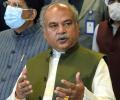
Responding to the NCP leader's remarks, Tomar said Pawar, who is a veteran leader, is also considered well-versed with the issues and solutions relating to agriculture. "Pawar himself tried hard to bring the same agriculture reforms earlier."
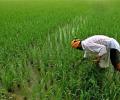
Prime Minister Narendra Modi on Saturday released Rs 20,946 crore to 10.09 crore farmers across India as the 10th installment of financial aid under the PM-KISAN scheme and said there was a need for innovation in agriculture along with promotion of natural farming. Under the Pradhan Mantri Kisan Samman Nidhi (PM-KISAN) scheme, a financial benefit of Rs 6,000 per year is provided to the eligible farmer families, payable in three equal installments of Rs 2,000. The PM-KISAN scheme was announced in the February 2019 Budget.

Pakistan Prime Minister Shehbaz Sharif will take the USD 60 billion China-Pakistan Economic Corridor forward with new vigour, vitality and in a rejuvenated manner, ensuring the multifaceted development of the flagship project of China's ambitious Belt and Road Initiative, a top leader of the ruling PML-N has said.
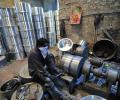
With the Covid-19 pandemic showing signs of ebbing and economic activity picking up, factory owners in Jalandhar had hoped that the worst was over. However, the heat wave in April and extensive power cuts that came with it, have crushed their hopes. The city's large number of micro, medium and small enterprises (MSMEs) are now gearing up for yet another struggle, this time to survive with the shortage of power that is severely impacting their operations.

The most immediate challenge for growth is the disruption of the global economy brought about by the Ukraine war and related sanctions, the Covid shutdowns in China and the rising tide of inflation, points out Nitin Desai.
But the measures, particularly in agriculture, may not be enough to revive the sector and double the farm income, says S Mahendra Dev.
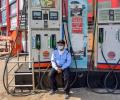
Hitting out at Prime Minister Narendra Modi over the issue of tax cuts on petroleum products, Tamil Nadu Chief Minister M K Stalin on Thursday said people were aware of the fact behind the issue and pointed out at his government effecting a Rs 3 a litre cut on petrol earlier.

Reliance Industries chairman Mukesh Ambani might have made news for purchasing the most expensive beach-side villa in Dubai recently, but he is not the only Indian eyeing the city for investment. Since Dubai allowed foreign investors full ownership in specific sectors in June 2021, a horde of Indian companies have moved or expanded into the desert city. The list even includes a kindergarten, an elementary and middle school, and a hotel that has sought 100 per cent ownership.
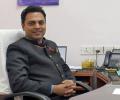
Chief Economic Adviser (CEA) K V Subramanian on Tuesday exuded confidence that India would achieve double-digit growth in the current financial year on the back of policy initiatives and continuing reforms. He also said the country is well poised to meet the fiscal deficit target of 6.8 per cent of GDP. "At this stage, I can say confidently that we should be able to achieve that fiscal deficit number. "Any shortfalls that might happen on the disinvestment side will also be accompanied by positive surprises that have happened on tax revenue," he told reporters.
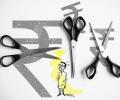
The government, under the Finance Act, 2020, had allowed tax exemption for SWFs and pension funds in the case of incomes from investment in 34 key infrastructure sectors, including hotels, cold chains, educational institutions, hospitals, and gas pipelines.

The Tamil Nadu Assembly on Saturday adopted a resolution urging the Centre to withdraw three contentious farm laws, against which farmers have been holding protests outside Delhi for months.
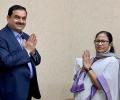
The words 'industry', 'industrial development', 'jobs', and 'employment' have been ringing with higher frequency since Mamata Banerjee stepped into her third term with landslide victory after a high-octane election last year. "Our government's next target is industrial development," the chief minister (CM) had been heard stating at different public meetings in the past few months - perhaps setting the tone for the sixth edition of the Bengal Global Business Summit (BGBS) slated for later this month. Investor summits by any state are about intent, big numbers, and tall claims. Yet in competitive federalism, its importance as a marketing tool is undeniable.

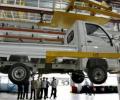
Tata Motors on Monday launched the country's first CNG truck in the medium and heavy commercial (M&HCV) vehicle segment in the 28- and 19-tonne nodes. Most truck makers, including Tata Motors, currently offer CNG only in the small and light commercial vehicle segments. The company also launched a fleet of seven trucks in the intermediary and light commercial vehicle (I&LCV) segment, meant for varied applications.

India has evinced interest in building refineries and petrochemical plants in Iraq and is keen to source liquefied natural gas (LNG) from its second largest oil supplier.

The minister noted that while there is an agitation going on one side, there are also lakhs of farmers coming in support of these laws.

'An earthquake of a slightly higher magnitude in the Western Himalayan region is going to be catastrophic -- not just because of the fragility of the region but because of how densely we have occupied it.'
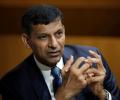
Sounding a note of caution, former Reserve Bank Governor Raghuram Rajan has said that India is "dangerously close" to the Hindu rate of growth in view of subdued private sector investment, high interest rates and slowing global growth. Rajan said that sequential slowdown in the quarterly growth, as revealed by the latest estimate of national income released by the National Statistical Office (NSO) last month, was worrying. Hindu rate of growth is a term describing low Indian economic growth rates from the 1950s to the 1980s, which averaged around 4 per cent.

During his address after flagging off the train via video-conferencing, Modi said his government's policies are clear and intentions transparent in reforming the agriculture sector.

In his address after more than 75,000 people were given appointment letters for various government jobs in the first tranche, Modi acknowledged the challenges facing the economy the world over with many countries hit by a record inflation and unemployment and said India is making every effort to come out of the situation unscathed.

Modi said at a time when people are about to vote for the future of the state, "I want to offer you gratitude for your blessings and affections."

Consumers are paying an exorbitant 180 per cent tax on petrol, and 140 per cent on diesel in Delhi and in most other towns in India. Little wonder then that the central government expects a staggering Rs 3.46 trillion by levying excise duties on retail sale of the two fuels this year, and Rs 3.2 trillion the next. States would generally have had reason to cheer, as they command a 41 per cent share in Centre's tax revenues. But as the Centre has raised excise duties in the form of "cess," the revenue proceeds are by nature not shareable with states.

Prime Minister Modi has certainly pulled back, and his political capital -- dependent as it is on an image that he knows best and never retreats -- may have taken a bit of a beating. But, equally, it is hard to say that the protesters have 'won', argues Mihir S Sharma.

'That is the one headline the world is reading about India this week, and it is a potentially damaging story...' 'I don't think a panic mentality has set in, but this story is one that investors and market watchers are absolutely seized with.'

The government will amend the six-and-a-half-decade old Essential Commodities Act to deregulate food items, including cereals, edible oil, oilseeds, pulses, onion and potato, Finance Minister Nirmala Sitharaman said on Friday. The amendment, besides deregulating production and sale of food products, will provide for no stock limit to be imposed on any produce.

A closer look at the data reveals that a lot of the items are not part of this calculation. The notable ones include buffalo meat, marine exports, raw cotton, and plantation crops such as tea, coffee, rubber, etc.

At an event at Chhatrapati Shivaji Maharaj Terminus in south Mumbai, Modi first flagged off the the CSMT-Solapur Vande Bharat Express and later another semi high-speed train linking the financial capital to Sainagar Shirdi temple town in Ahmednagar district.

This will be done across five cities - Delhi, Bengaluru, Coimbatore, Bhopal, and Shillong. Thereafter, it will be scaled up and launched in 100 cities over a period of six months, said a senior government official.

'It has been an ongoing process, talking to the relevant ministries about eliminating leakages and curbing non-core expenditure in various schemes.'

We have our own problems for sure and they are not trivial, but for now, our economy is in not too bad a shape, our politics is as personality-driven and authoritarian as that of most countries in the world. We must make the best of what we have and not be excessively unhappy looking at the grass on the other side of the septic tank which may not be greener after all!, observes Shreekant Sambrani.

Prime Minister Narendra Modi on Thursday said India has become the fifth largest economy in the world and this is not an ordinary achievement. "Every Indian is feeling proud of it. We need to maintain this enthusiasm," Modi said. He was virtually addressing beneficiaries of various government schemes and those present at a mega medical camp organised in Olpad area of Surat city in Gujarat, where the Assembly polls are due later this year.

The agreement has ended a wartime standoff that had threatened food security in several countries and cleared the way for exporting tons of Ukrainian grains.

'We had tremendous faith in honorable Modiji in his second term as he was well-settled. Sadly that has been belied.'

In televised remarks after Finance Minister Nirmala Sitharaman presented the budget, Modi said it has many provisions for the agriculture sector, including for making loans easier for farmers.

State School Education Minister Anbil Mahesh Poyyamozhi said he and Public Works Department Minister EV Velu consoled the parents of the girl whose body was found in the school hostel on July 13.

Three key agriculture Bills, approved by the Lok Sabha, are facing staunch opposition from within the ruling coalition with senior minister Harsmirat Kaur Badal resigning in protest and farmers hitting the street.

NITI Aayog has been working on an action plan to relieve rural distress and energise the agricultural sector

Modi's critics will say that he has put up cement and steel structures, but weakened the institutions of governance whereas Nehru strengthened them, observes T N Ninan.
Industry representatives have said from the second half of the year, they hope to see revival because the rural economy is looking up and the projects the government has announced.

The only real solution to the jobs crisis, whether in India or abroad, is to direct tech innovation towards job enhancing sectors, and disincentivising job-replacing ones, observes R Jagannathan.
Nirmala Sitharaman's maiden Budget has not disappointed but vision and details, particularly for the revival of agriculture, are missing.
